
Dumpling Wrapper Production: Processes, Machines, and Automated Lines

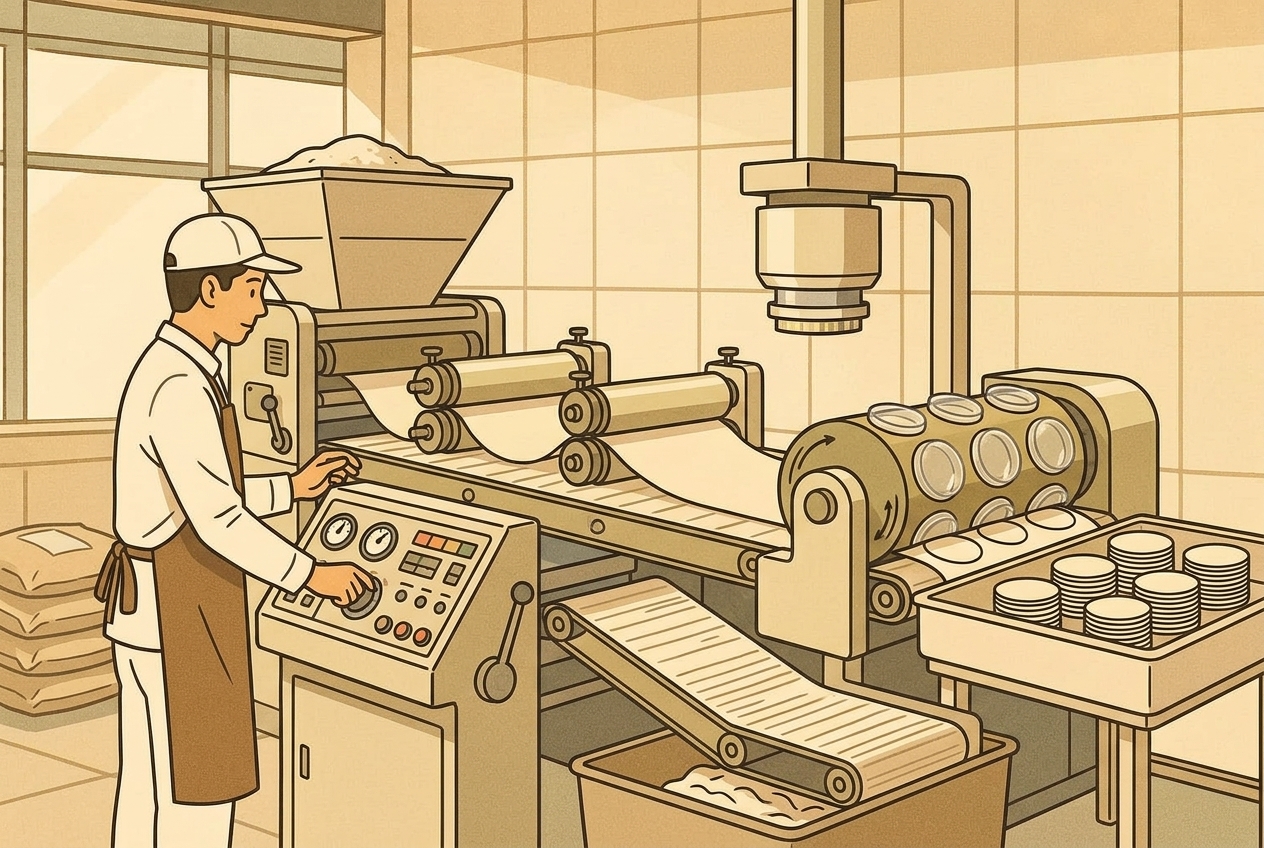
The dumpling wrapper production process may look simple, but from mixing flour, water, and salt, to dough maturation, compounding, rolling, thinning, cutting, separating, and stacking, every step affects the thickness, toughness, extensibility, and appearance of the finished wrapper.
For food factories, when demand for dumpling and wonton wrappers grows from small batches to mass production, traditional manual methods can no longer balance output with consistent quality. Connecting each process into a complete dumpling wrapper production line with professional dumpling wrapper machines and automated equipment has therefore become an important way to improve production efficiency.
Fully automatic dumpling wrapper machines in particular integrate dough processing, rolling, wrapper cutting, and downstream handling, helping food factories reduce labor requirements while maintaining stable product specifications.
Below is a complete introduction to the dumpling and wonton wrapper production process, with an in-depth look at the dumpling wrapper machines and fully automatic production lines commonly used in food factories.
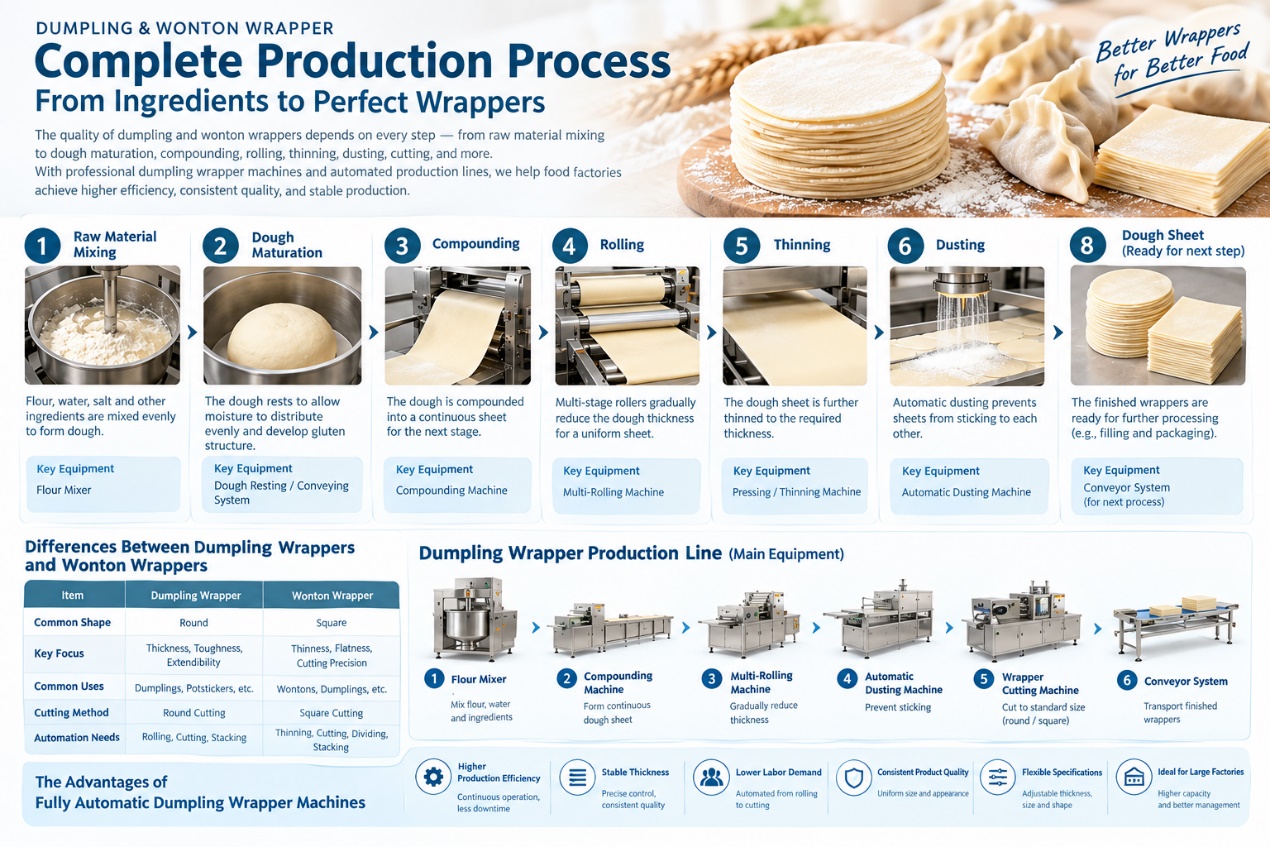
1. Dumpling Wrapper Production Process: From Flour to Finished Wrapper
A complete dumpling wrapper production process usually includes the following main stages:
Food factories adjust equipment configurations according to product specifications, output, and level of automation, but the core principle is the same: stable dough processing and precise rolling to produce wrappers of uniform thickness.
2. Raw Material Mixing: The Starting Point of Wrapper Quality
Dumpling wrapper production starts by mixing flour and water.
Depending on product requirements, the recipe may include a suitable amount of salt or other food ingredients. A flour mixer then blends everything evenly so that the flour fully absorbs water and forms a dough with the right gluten strength and extensibility.
This stage mainly controls:
- The ratio of flour to water.
- Dough moisture content.
- Mixing uniformity.
- Dough gluten strength and extensibility.
Stable dough is the foundation of the rolling process. If the moisture content is unstable, problems such as uneven dough sheet thickness, tearing, or poor conveying may occur once the dough enters the dumpling wrapper machine.
For this reason, automated production lines are usually equipped with quantitative feeding and automatic water-adding systems to improve recipe consistency from batch to batch.
3. Dough Maturation: Making the Dough Structure More Stable
After mixing, the dough usually needs a suitable period of maturation or resting, so that moisture distributes more evenly inside the dough and the gluten structure gradually stabilizes.
Maturation conditions vary with the type of flour, product specifications, and production equipment.
Well-conditioned dough makes the following rolling process smoother and reduces:
- Dough sheet tearing.
- Wrapper shrinkage.
- Uneven thickness.
- Deformation during cutting.
In mass production, stable dough is what allows the whole dumpling wrapper production line to run continuously for long periods.
4. Compounding and Rolling: The Core of the Production Process
Once the dough is ready, it enters the compounding and rolling stage.
Compounding equipment first processes the dough into a continuous dough sheet, which is then gradually thinned by multi-stage rollers.
This is one of the most important processes of a dumpling wrapper machine.
A dumpling wrapper is not pressed to its final thickness in one pass. Multiple roller stages reduce the thickness step by step, giving the wrapper a more uniform structure.
Key Control Points of Dumpling Wrapper Rolling Equipment
- Multi-stage rollers for gradual rolling.
- Adjustable speed for each roller stage.
- Variable frequency control for stable dough sheet conveying.
- Adjustable wrapper thickness according to product requirements.
- Maintaining dough sheet flatness and extensibility.
Different products require different thicknesses, so dumpling wrapper equipment must offer a certain range of specification adjustment.
For example, standard dumpling wrappers, thin-skin dumpling wrappers, and wrappers of different sizes can all be produced by adjusting rolling and cutting specifications.
5. Wonton Wrapper Making: Greater Emphasis on Thinness and Cutting Precision
Besides dumpling wrappers, wonton wrapper production also goes through mixing, maturation, rolling, and cutting.
Wonton wrappers are usually thinner, so they demand higher rolling accuracy and wrapper flatness.
In wonton wrapper production, the dough moisture content must be controlled consistently, and the dough sheet must be rolled stage by stage so that the final wrapper reaches the required thickness.
Cutting equipment then processes the sheet into square wonton wrappers of standard size.
Processing Differences Between Dumpling Wrappers and Wonton Wrappers
| Item | Dumpling Wrapper | Wonton Wrapper |
|---|---|---|
| Common Shape | Round | Square |
| Key Focus | Thickness, toughness, extensibility | Thinness, flatness, cutting precision |
| Common Uses | Dumplings, potstickers, etc. | Wontons, dumplings, etc. |
| Cutting Method | Round cutting | Square cutting |
| Automation Needs | Rolling, cutting, stacking | Thinning, cutting, separating, stacking |
Therefore, although both are dough wrapper products, dumpling wrappers and wonton wrappers still require different equipment configurations and process parameters according to the product.
6. Dusting: Ensuring Wrappers Separate Smoothly
After rolling, wrappers tend to stick to one another, so production usually needs dusting equipment to prevent sticking.
An automatic dusting system keeps a suitable anti-stick effect on the wrapper surface.
The amount of dusting flour must be properly controlled:
- Too little flour may cause wrappers to stick together.
- Too much flour may increase material loss.
- Uneven dusting may leave some areas still sticking.
A stable automatic dusting mechanism is therefore one of the key pieces of equipment in a modern dumpling wrapper production line.
7. Cutting: Turning a Continuous Dough Sheet into Standard Wrappers
Once the wrapper reaches the set thickness, it enters the cutting stage.
Dumpling wrappers are usually cut from the continuous dough sheet into standard sizes with round cutters.
Wonton wrappers, on the other hand, are produced by square cutting.
The precision of cutting equipment directly affects the efficiency of the filling process that follows.
Wrappers of consistent size make it easier for filling equipment to control the weight and position of the filling, and also give the final product a more consistent appearance.
In an automated dumpling wrapper production process, cutting equipment is therefore an essential link.
8. Wrapper Separating and Stacking: Improving Automated Production Efficiency
After cutting, wrappers must be separated, arranged, and stacked.
Manual handling not only requires a lot of labor, but can also lead to inconsistent stack counts due to differences in operating speed.
Modern dumpling wrapper machines can therefore integrate automatic conveying, separating, and stacking functions according to production needs.
For example, cut wrappers can be stacked into groups of a fixed quantity and then conveyed to packaging equipment.
As a result, you can achieve:
- More consistent wrapper counts.
- Neater stacking.
- Less manual handling.
- Higher efficiency in downstream packaging.
9. What Are the Main Equipment in a Dumpling Wrapper Production Line?
A complete dumpling wrapper production line is configured with different equipment according to the factory’s output and level of automation.
Common equipment includes:
| Production Stage | Main Equipment | Function |
|---|---|---|
| 01Raw Material Mixing | Flour Mixer | Mixes flour, water, and recipe ingredients |
| 02Dough Handling | Resting / Conveying Equipment | Stabilizes and conveys the dough |
| 03Compounding | Compounding Machine | Forms the dough into a continuous dough sheet |
| 04Rolling | Multi-Stage Rolling Machine | Gradually reduces wrapper thickness |
| 05Dusting | Automatic Dusting Machine | Prevents wrappers from sticking to each other |
| 06Cutting | Dumpling Wrapper Cutting Machine | Cuts into standard round wrappers |
| 07Separating | Wrapper Separating Device | Separates the cut wrappers |
| 08Stacking | Automatic Stacking Machine | Stacks neatly by set quantity |
| 09Packaging | Automatic Packaging Machine | Completes bagging, sealing, and product conveying |
Food factories can choose semi-automatic, fully automatic, or customized full-line configurations according to their actual needs.
10. Advantages of Fully Automatic Dumpling Wrapper Machines
When a food factory’s demand reaches large-scale continuous production, a fully automatic dumpling wrapper machine can integrate manual processes that used to be separate into continuous processing.
Compared with traditional manual methods, fully automatic equipment offers these main advantages:
1. Higher Production Efficiency
Dough can continuously enter the equipment for compounding, rolling, and cutting, reducing manual waiting and handling time.
2. More Stable Thickness
Multi-stage rollers and automatic control reduce the thickness differences caused by manual rolling.
3. Lower Labor Demand
From dough sheet conveying to cutting, separating, and stacking, everything can be integrated and automated.
4. Higher Product Consistency
Fixed equipment parameters and cutting specifications help keep every batch consistent.
5. Flexible Product Specifications
Wrapper thickness, size, and cutting form can be adjusted for different dumpling and wonton products.
6. Suitable for Large Food Factories
For food factories that need long continuous production, automated equipment can effectively improve overall output and production management efficiency.
11. How Do Dumpling Wrapper Machines Help Food Factories Increase Output?
When choosing dumpling wrapper machines, food factories should not look only at the speed of a single machine.
What really determines overall output is whether the process flows smoothly from mixing and rolling to cutting and stacking.
When planning a dumpling wrapper production line, the following should be considered together:
- Expected hourly output.
- Wrapper size.
- Wrapper thickness.
- Dough recipe.
- Cutting method.
- Stack quantity.
- Packaging format.
- Factory space.
- Whether automatic filling equipment will be connected later.
Only by planning the whole line, rather than simply buying individual machines, can the benefits of automated production be fully realized.
12. Kuo Cang Machinery: Customized Dumpling Wrapper Production Equipment
Dumpling and wonton wrappers are everyday foods, but producing them in large volumes with stable and consistent quality takes precise mechanical design and automated control.
From dough mixing to compounding, rolling, thinning, dusting, and cutting, every step affects final product quality.
Since 1967, Kuo Cang Machinery has been engaged in noodle machinery and food machinery, accumulating years of experience in equipment design, manufacturing, and automation integration. According to each food factory’s output, product specifications, and plant conditions, we plan suitable dumpling wrapper and wonton wrapper production equipment.
Through CNC precision machining, automated control, and customized equipment design, we help food factories improve production efficiency, reduce labor costs, and build stable noodle and wrapper production processes.
Whether you need a stand-alone dumpling wrapper machine or a complete fully automatic dumpling wrapper production line, we can plan it according to your actual needs.
13. Want to Build Your Own Fully Automatic Dumpling Wrapper Production Line?
Whether you are planning a new food factory, expanding existing capacity, or upgrading a traditional manual process to automated production, Kuo Cang Machinery can provide equipment planning and technical advice based on your actual needs.
We can help you:
- Evaluate dumpling and wonton wrapper output requirements.
- Plan a complete dumpling wrapper production line.
- Design rolling and cutting equipment.
- Customize dumpling wrapper machines to your product size and thickness.
- Integrate upstream and downstream automation equipment.
- Provide equipment installation, technical support, and after-sales service.
A good dumpling wrapper is never just about “rolling the dough thin”.
From ingredient ratios and dough condition to rolling thickness, cutting precision, and automatic stacking, every step needs precise control.
From stand-alone equipment to complete automated production lines, Kuo Cang Machinery can plan a more efficient and more stable wrapper production system for your needs.